Login
Login Help Center
 How to get verified

Fraud Article
How Identity Verification combats fraud and powers growth for BNPL providers
Buy Now Pay Later (BNPL) is growing rapidly due to customer demand, but online fraudsters pose a significant threat to today’s providers. Discover why identity verification can ensure a swift, seamless, and secure process for businesses and customers.

Buy Now Pay Later (BNPL) is scaling fast, and fraud is scaling right alongside it. Soft credit checks alone can’t stop account takeover, synthetic identity, and friendly fraud. Identity verification (IDV) closes that gap — and it does more than block bad actors: automated checks can clear customers in about six seconds and cover more than 12,500 government-issued ID types. For BNPL providers, IDV isn’t a compliance tax. It’s a growth lever that also shuts the door on fraud.
Recommendation: Treat identity verification as core onboarding infrastructure, not a bolt-on compliance check, and layer it with behavioral and device-level signals to catch fraud patterns that credit checks can’t see.
Why this matters now
Customer demand is pushing BNPL providers toward rapid growth over the next few years, and that growth is exactly what’s attracting online fraudsters — putting both the business and its legitimate customers at risk. Surface-level credit checks, which only assess creditworthiness, aren’t built to catch this.
The three fraud types BNPL providers face
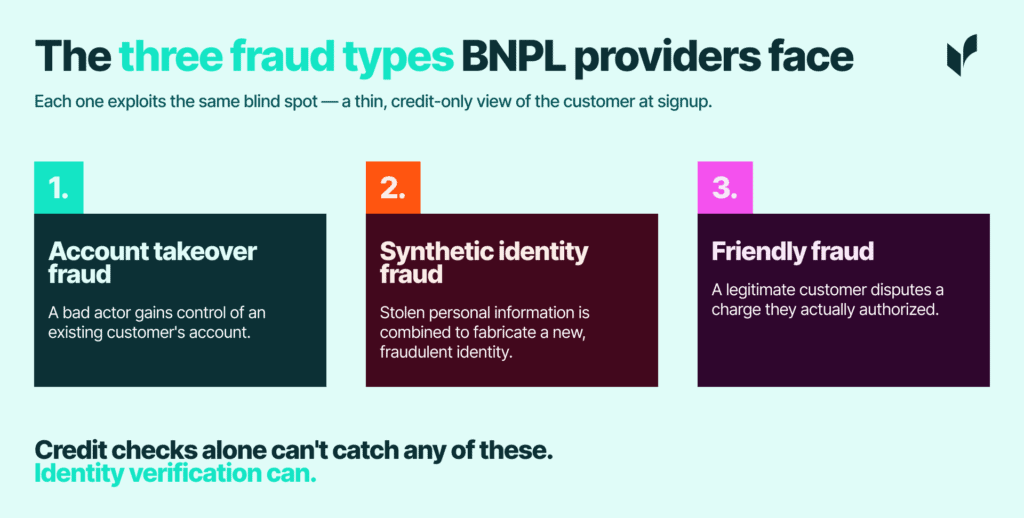
- Account takeover fraud — a bad actor gains control of an existing customer’s account.
- Synthetic identity fraud — stolen personal information is combined to fabricate a new, fraudulent identity.
- Friendly fraud — a legitimate customer disputes a charge they actually authorized.
Each one exploits the same weakness: a thin, credit-only view of the customer at signup.
What IDV actually fixes
Identity verification strengthens onboarding, prevents fraud before it happens, limits potential harm, and protects providers from monetary and customer loss tied to account takeover. Layered onto that, real fraud defense looks like:
- Face blocklisting — screens new sign-ups against historical and current data to catch repeat offenders before they get in.
- Cross-linking — combines device, network, and personal data in real time to spot sessions run by the same bad actor under different identities.
- Velocity abuse controls — automatically stop the same user from opening multiple accounts, taking out multiple loans, or farming sign-up bonuses.
- Network and device analytics — fingerprints the device and network behind each session and runs that data through KYC checks.
The growth case, not just the defense case
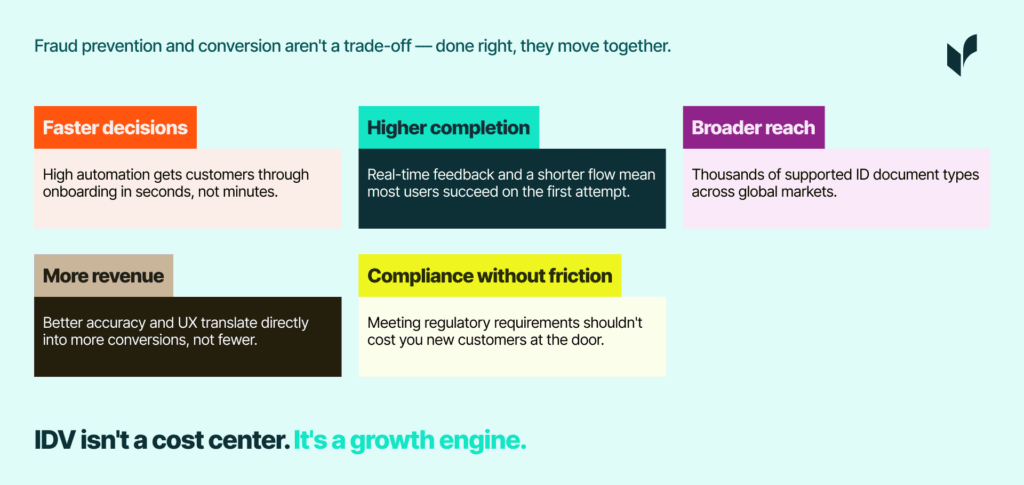
Fraud prevention and conversion aren’t a trade-off — done right, they move together:
- Faster decisions — high automation gets customers through onboarding in seconds, not minutes.
- Higher completion — real-time feedback and a shorter flow mean most users succeed on the first attempt.
- Broader reach — thousands of supported ID document types across global markets.
- More revenue — better accuracy and UX translate directly into more conversions, not fewer.
- Compliance without friction — meeting regulatory requirements shouldn’t cost you new customers at the door.
The takeaway
BNPL providers still leaning on credit checks alone are exposed on two fronts: fraud losses and lost conversions from clunky onboarding. Identity verification, layered with behavioral fraud signals like blocklisting, cross-linking, and velocity controls, addresses both at once — faster, safer onboarding that scales with demand instead of buckling under it.

Unlock safer BNPL growth
Discover more about how IDV is powering BNPL sector growth and customer acquisition in the fight against stolen identities.